
Guiding Questions
In this blog we’re going to be investigating what the doctor does about your blood smears during a check-up. A lot of people don’t know what doctors are looking for, and they have questions like:
- What are the reasons for needing a blood smear?
- How is a blood smear done?
Blood Cells
In order to understand blood smears fully, we’ll have to learn about the different types of cells in blood. There are 3 main types, red blood cells, white blood cells, and platelets.
- Red Blood Cells: Also known as erythrocytes, these are the stereotypical red button shaped cells. Their main function is to carry oxygen
- White Blood Cells: Also known as leukocytes, white blood cells are a type of immune cell. Their main job is to eliminate any pathogens in the blood.
- Platelets: Also known as thrombocytes. These aren’t true cells, but in fact cell fragments. The main job of platelets is to help with blood clotting.
Indications For A Blood Smear
The main reasons for a doctor needing a blood smear are malaria, anemia, and cancer. Usually, if a doctor suspects an issue with the blood, and if blood panels show abnormal results, a blood smear is the next step. Let’s learn about these 3 issues and how a blood smear can find them.
- Malaria: Malaria is caused by a parasite that lives inside red blood cells. Under a blood smear, early stages look like purple dots inside the red blood cells. Advanced stages show misshapen cells and the entire cell having a purple color.
- Anemia: Depending on the type of anemia, red blood cells can have different shapes and sizes. In sickle cell anemia, red blood cells are thin, long, and fragile. In iron deficiency anemia, red blood cells could look like rings or other incorrect shapes.
- Cancer: A blood smear can also help diagnose cancer. Blood smears especially help with white blood cell cancers like leukemia. Based on the form and excessive count of the white blood cells found in the smears, cancer could be a likely diagnosis.
Steps Of A Blood Smear
Let’s go over the steps of how a doctor or lab technician performs a blood smear.
- Collection: A small sample of blood is taken, usually via a standard blood draw from a vein or a quick finger prick. To keep the blood from clotting before it reaches the slide, it is often collected in a tube containing an anticoagulant called EDTA.
- Creating A Smear: A tiny drop of blood is placed near one end of a clean glass slide. A second glass slide, called the spreader slide, is held at a 30° to 45° angle.The spreader is pulled backward until it touches the drop. Once the blood spreads along the edge of the spreader slide, the technician quickly and smoothly pushes it forward across the length of the base slide. The goal is to create a feathered edge, a region at the end of the smear where the cells are spread so thin they form a single layer.
- Air Drying And Fixation: The slide is allowed to air dry completely. Once dry, it is “fixed” (usually with methanol). Fixation “freezes” the cells in place and preserves their structure so they don’t degrade or wash away during the next step.
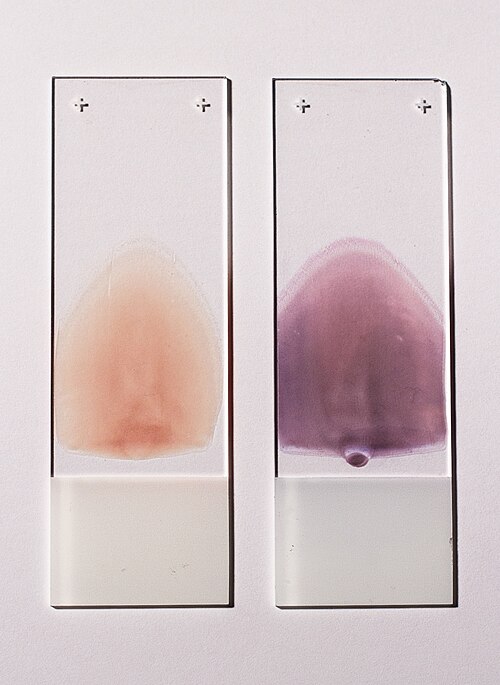
- Staining: Since blood cells are mostly translucent under a microscope, they need color to be visible. The slide is dipped into or flooded with special dyes. Methylene Blue stains the DNA/nuclei of white blood cells purple, while Eosin stains the red blood cells a pink or salmon color.
- Microscopic Examination: Finally, a laboratory professional or a hematopathologist examines the slide under high power and any findings are noted.
Review
Here are some questions to review your knowledge about blood smears.
- Platelets are also known as? Thrombocytes
- What is an example of a white blood cell cancer? Leukemia
- What angle is the spreader slide held at? 30 To 45 Degrees
- What step must be done in order for the cells to be seen? Staining
DISCLAIMER: THIS BLOG POST DOES NOT PROVIDE MEDICAL ADVICE
The blog post and everything contained on it is for informational purposes only. No material on this site is intended to be a substitute for professional medical advice, diagnosis or treatment. Always seek the advice of your physician or other qualified health care provider with any questions you may have regarding a medical condition or treatment and before undertaking a new health care regimen, and never disregard professional medical advice or delay in seeking it because of something you have read on this website.

Recent Comments