
The Science of Cave Carving
Karst landscapes are created through chemical weathering, where slightly acidic water slowly dissolves a specific type of rock called limestone.
- The Key Rock: The formation begins with limestone, a bedrock made almost entirely of the mineral calcite (calcium carbonate).
- The Acid Weapon: Rainwater is naturally slightly acidic because it absorbs carbon dioxide (CO₂) from the air. When H₂O and CO₂ mix, they form carbonic acid.
- Dissolution Power: The carbonic acid chemically reacts with the limestone (calcite), slowly dissolving the rock over thousands of years to carve out huge underground passages.
Features of a Karst Landscape
The defining features of a Karst region are its unique surface geology and the striking mineral formations inside the caves.
Sinkholes: Bowl-shaped depressions formed when the roof of an underground cave collapses.
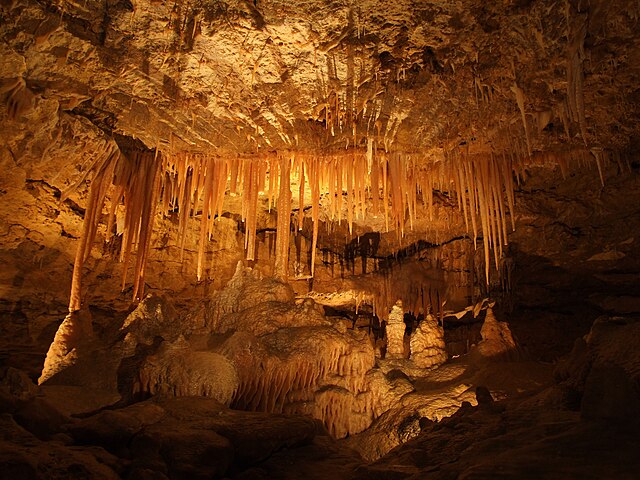
Cave Formations (Speleothems): Water dripping through the cave ceiling leaves behind dissolved calcite, which slowly recrystallizes into formations:
- Stalactites: Formations that hang TIGHT to the ceiling.
- Stalagmites: Formations that grow MIGHTY tall from the ground.
Cave life: Many creatures adapt to darkness—pale fish, bats, insects—often with slow growth and keen senses.
Fun Facts
Here are some interesting facts about caves and karst:
- The largest known cave system, Mammoth Cave in Kentucky, is over 675 km (420 miles) long—longer than the entire state of Rhode Island!
- Cave formations can trap clues about past climates (ancient rain patterns) in their layers.
- A stream can vanish into a sinkhole in karst areas and reappear miles away as a spring.
- Cave formations grow incredibly slowly, often less than 1 centimeter every 100 years.
Review
Let’s quickly recap what we learned about caves and karst:
- What type of rock is dissolved to form a Karst landscape? Limestone
- What is the weak acid created when rainwater absorbs carbon dioxide? Carbonic Acid
- What cave formation grows up from the floor? Stalagmite
- What is the name for the bowl-shaped depression caused by a collapsed cave roof? Sinkhole

Recent Comments