
What Is Friction?
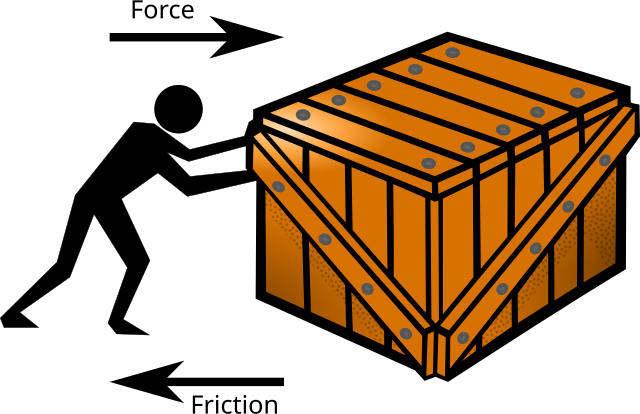
Friction is a contact force that resists motion when two surfaces rub against each other. Friction works in the opposite direction of motion.
It depends on two main things:
🔹 The roughness of the surfaces
🔹 The force pressing them together
There are different types of friction:
🔹 Static friction: keeps objects at rest
🔹 Sliding friction: acts while an object moves
🔹 Rolling friction: acts on wheels
🔹 Fluid friction: occurs in air or water (like air resistance)
- It is measured in newtons (N), like any other force.
- Friction converts kinetic energy into thermal energy, so surfaces get warm when rubbed.
What is Inertia?
Inertia is an object’s resistance to any change in motion.
Newton’s First Law of Motion explains inertia: ”An object in motion stays in motion, and an object at rest stays at rest unless acted on by a force.”
- The more mass an object has, the more inertia it has. A bowling ball is harder to stop than a tennis ball.
- Inertia is why it’s harder to start or stop heavy objects.
Real-life applications:
- Car airbags and seatbelts help manage inertia by slowing your body down safely in a crash.
- Inertia wheels are used in satellites and spacecraft to help control rotation without fuel.
Fun Facts
Here are some interesting facts about friction & inertia:
- Space has almost no friction, so satellites keep orbiting without slowing down.
- Ball bearings reduce friction by rolling instead of sliding.
- Ice skating works well because there’s little friction between the skate blade and the ice.
- Trains use sand to increase friction on tracks during braking!
Review
Let’s quickly recap what we learned about friction & inertia:
- What force resists motion? Friction
- What law explains inertia? Newton’s First Law of Motion
- What kind of friction happens in air or water? Fluid Friction
- What makes it harder to start or stop heavy objects? Inertia

Recent Comments