
How Robots Assist in Surgery
Medical robots are transforming surgery by making it more precise and less risky.
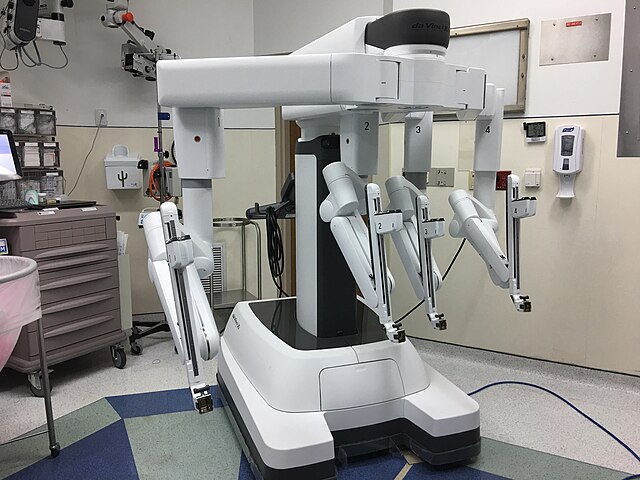
- Degrees of freedom: Surgical robots like the da Vinci system have up to 7 flexible joints, so they can twist, rotate, and bend like a human wrist.
- Motion scaling: When the surgeon moves the controls by 3 inches, the robot’s tool moves 1 inch inside the body, allowing tiny, delicate cuts or stitches.
- Tremor filtering: Built-in systems filter out small hand shakes (physiological tremors), so the robot’s movements stay perfectly smooth and steady.
Robots Beyond the Operating Room
Robots don’t just help in surgery — they also support patients during recovery.
- Physical therapy robots can help people relearn how to walk after an injury or stroke.
- Exoskeleton robots act like wearable suits that support muscles and joints.
- They use force sensors to tailor support as you improve.
- Some hospitals use robotic carts to deliver medicines or meals so that nurses can focus more on patient care.
- Some robots use AI to adapt rehab exercises over weeks.
Fun Facts
Here are some interesting facts about robotics in medicine:
- The first robot-assisted surgery was done in 1985, on the brain!
- Some surgical robots can move just 0.5 millimeters, which is thinner than a strand of hair!
- Robots can even be controlled from thousands of miles away using special internet systems (called “telesurgery”).
- New soft robots are designed to move like worms or octopuses inside the body to do repairs.
Review
Let’s quickly recap what we learned about robotics in medicine:
- What does motion scaling in surgical robots improve? Precision
- What type of robot helps people walk again? Exoskeleton
- How can doctors use robots from miles away? Telesurgery
- What filters out tiny handshakes in surgical robots? Tremor Filtering

Recent Comments