
Guiding Questions
- What are the eyes?
- What are the parts of the eyes?
- What are the functions of the eyes?
Overview
Have you ever used a camera to take a picture? A camera collects light through a lens and focuses it to create an image.
Your eyes work in a very similar way. Just like a camera lens focuses light to make a clear picture, your eyes focus light so your brain can understand what you are seeing. In this way, your eyes act like natural cameras for your body.
Your eyes are very important organs that allow you to see the world around you. They collect light and send information to your brain so you can understand what you are looking at.
The eyes work together with the brain and the nervous system to create vision. When light enters the eyes, special cells send signals through the optic nerve to the brain. The brain then processes these signals and turns them into the vivid images you see every day.
Parts of the Eye
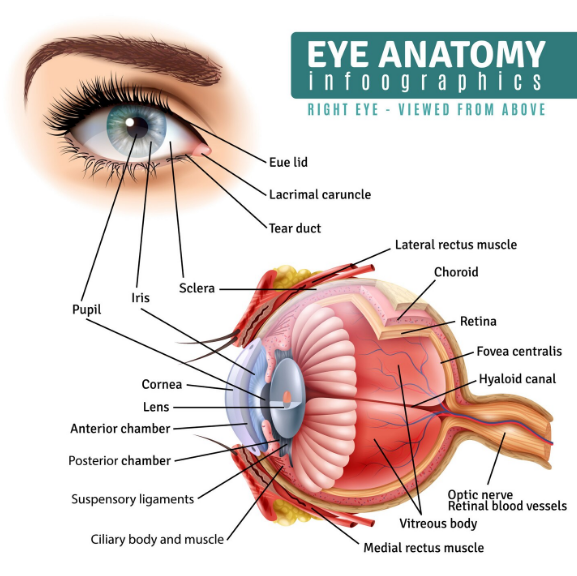
There are several important parts of the eye that help create vision.
The cornea is the clear, dome-shaped surface at the front of the eye. It helps protect the eye and bends light so it can enter properly.
The iris is the colored part of the eye. It controls how much light enters the eye by adjusting the size of the pupil.
The pupil is the dark opening in the center of the eye. Light enters the eye through the pupil.
The lens is located behind the pupil. It focuses light so that images appear clearly.
The retina is a thin layer of tissue at the back of the eye. It contains special cells called photoreceptors that detect light and convert it into signals for the brain.
The optic nerve carries these signals from the retina to the brain so the brain can process the information and create the image you see.
Eye Functions
The main function of the eyes is to provide vision.
Your eyes allow you to detect light, see colors, notice movement, and understand the shape and size of objects.
The eyes also work together to help with depth perception, which allows you to judge how far away something is.
Your eyes can quickly adjust to different lighting conditions. For example, when you enter a dark room, your pupils expand to allow more light into the eye.
The eyes also help protect themselves. Blinking spreads tears across the surface of the eye, which keeps the eyes moist and washes away dust or other small particles.
Eye Conditions
Sometimes the eyes or the parts that help create vision do not work properly. This can lead to a condition called blindness, which means a person has very limited vision or cannot see at all.
Blindness can happen for many reasons. It may occur if parts of the eye, such as the retina or optic nerve, become damaged. Certain diseases can also affect vision. For example:
- Glaucoma damages the optic nerve.
- Cataracts cause the lens of the eye to become cloudy.
Some people are born with vision problems, while others may develop them later in life due to illness, injury, or aging.
People with blindness often use tools such as braille, guide dogs, and special technology to help them navigate and read.
- Braille is a reading system made of raised bumps that are traced by the fingers; these raised dots represent letters and symbols, allowing people who cannot see to read by touch.
To help prevent eye conditions from developing or recognize them early, it is important to get regular eye exams regularly with the doctor and get proper medical care if needed.
Review
- What part of the eye controls how much light enters? The Iris
- What is the dark opening in the center of the eye called? The Pupil
- What part of the eye focuses light onto the retina? The Lens
- What part of the eye contains photoreceptors that detect light? The Retina
- What nerve carries signals from the eye to the brain? The Optic Nerve
DISCLAIMER: THIS BLOG POST DOES NOT PROVIDE MEDICAL ADVICE
The blog post and everything contained on it is for informational purposes only. No material on this site is intended to be a substitute for professional medical advice, diagnosis or treatment. Always seek the advice of your physician or other qualified health care provider with any questions you may have regarding a medical condition or treatment and before undertaking a new health care regimen, and never disregard professional medical advice or delay in seeking it because of something you have read on this website.

Recent Comments