
Guiding Questions
In this blog we’re going to be investigating IQ tests. A lot of people don’t know what IQ tests are, they have questions like:
- How does an IQ test work?
- What does my IQ score mean?
How Does An IQ Test Work?
IQ tests are frequently misunderstood. In order to air out the misconceptions let’s learn about how IQ tests are conducted.
- Administration and Environment: Most professional IQ tests are administered one-on-one by a trained psychologist. Every test-taker receives the same instructions, time limits, and environment to ensure the results are comparable to everyone else’s. To save time, the tester finds the level where you get everything right and stops at the point where questions become too difficult for you to answer correctly.
- The Core Subtests: A modern IQ test is a set of small subtests that target different cognitive domains. Verbal Comprehension measures vocabulary and abstract reasoning, perceptual reasoning measures visual-spatial processing, working memory measures the ability to hold and manipulate info, and finally processing speed measures mental efficiency and focus.
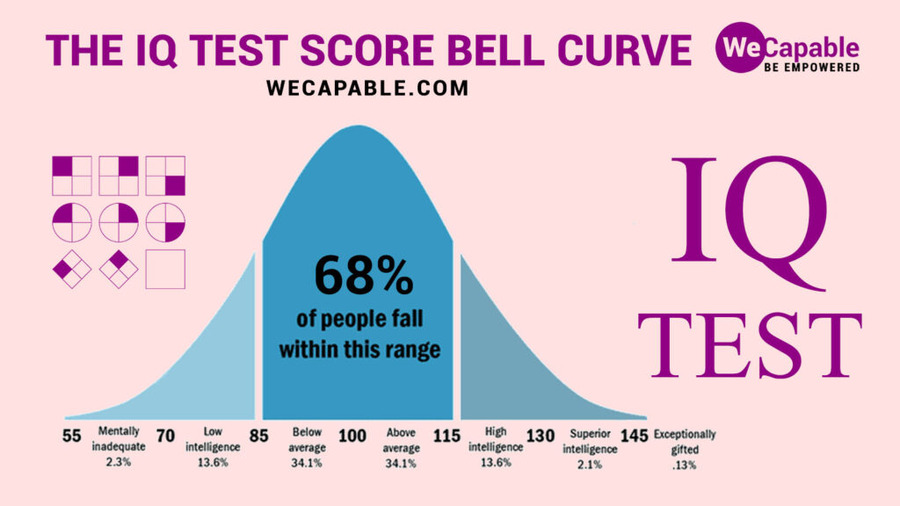
- Scoring: Once you finish, the psychologist tallies your raw points. However, a raw score of 50 means nothing on its own. Your score is compared to a norming group of people your exact age. About 68% score between 85 and 115. This is the average range.
- The Mathematical Calculation: IQ is a measure of where you fall relative to the average of the population. We use the concept of standard deviation, usually 15 points. The formula for a traditional IQ score is based on the normal distribution. The formula is: IQ=100+(15×(X−μ)/σ). Where X is your raw score, μ is average score for your age group, and σ is the standard deviation.
- Interpretation and Feedback: An IQ score is a snapshot of cognitive functioning at a specific time. Psychologists look for a scatter. For example, if you score a 130 in math logic but a 70 in processing speed, it may indicate a learning disability or a specific cognitive strength rather than just a single number.
IQ Score
This table contains ranges of IQ scores and what each of them mean.
| IQ Range | Classification | Percentage of Population |
| 130 and above | Very Superior (Gifted) | ~2.2% |
| 120–129 | Superior | ~6.7% |
| 110–119 | High Average | ~16.1% |
| 90–109 | Average | ~50.0% |
| 80–89 | Low Average | ~16.1% |
| 70–79 | Borderline | ~6.7% |
| 69 and below | Extremely Low | ~2.2% |
Review
Here are some questions to review your knowledge about IQ tests.
- How are professional IQ tests conducted? One On One With A Psychologist
- What is an IQ test composed of? Sub-Tests
- What is having an IQ above 130 classified as? Gifted
- What range is considered an average IQ? 90-109
DISCLAIMER: THIS BLOG POST DOES NOT PROVIDE MEDICAL ADVICE
The blog post and everything contained on it is for informational purposes only. No material on this site is intended to be a substitute for professional medical advice, diagnosis or treatment. Always seek the advice of your physician or other qualified health care provider with any questions you may have regarding a medical condition or treatment and before undertaking a new health care regimen, and never disregard professional medical advice or delay in seeking it because of something you have read on this website.

Recent Comments