
Guiding Questions
- What is the brain?
- What are the parts of the brain?
- What are the functions of the brain?
Overview
The leadership of large companies is very organized in order to efficiently run and conduct business. The leadership will often be divided into teams that oversee specific tasks such as human resources, finances, etc.
The brain works in a very similar way. The brain is an organ made mostly of fat that weighs about 3 pounds. It is located in the skull and operates using chemical signals via the spine, nerve network, and neurons. The various parts of the brain control different things, but are all equally important to the functioning of the human body.
Matter
When discussing matter in terms of the brain, there are two different types – gray matter and white matter.
Gray matter is the darker portion of the brain that is found in the outer parts. It processes and interprets information.
White matter is the lighter part found on the inside. It doesn’t actually try to comprehend information, but is involved in transmitting it to other areas within the nervous system.
The spinal cord also has gray and white matter, but the order is reversed – white matter is found on the outside and gray matter on the inside.
Parts of the Brain
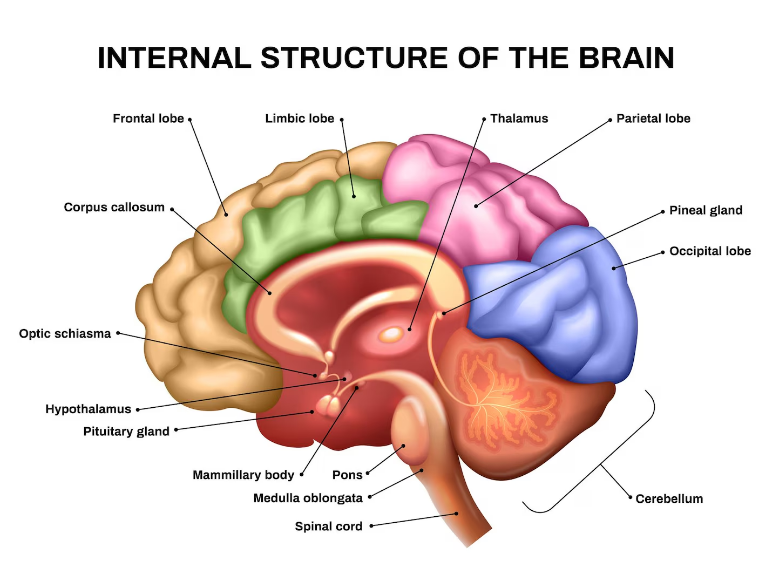
The brain can be divided into three main parts – the cerebellum, the cerebrum and the brainstem. There are also other parts that lie deeper within the brain but play just as crucial of a role.
The cerebellum, which translates to “little brain,” is a small part of the brain located in the back of the head that controls balance and posture along with other fine motor skills. It is composed of two hemispheres. The outer cerebellum has neurons, whereas the function of the inner cerebellum is to be able to communicate with the cerebral cortex.
The cerebrum is the largest part of the brain, located at the front of the head. It contains gray matter on the outside (the cerebral cortex) and white matter on the inside. It controls a variety of conscious activities including but not limited to movement, homeostasis (regulation of body temperature), thinking, speaking, and managing the 5 senses.
- The cerebral cortex is the folded and ridged gray matter that covers the cerebrum. Cortex actually translates to “bark” in Latin. It too has two hemispheres that communicate through the corpus callosum (a C-shaped white matter and nerve structure).
- The basal ganglia are deep structures within the cerebrum that help control movement.
The brainstem is the middle part of the brain that connects the brain to the spinal cord. It consists of three parts – the midbrain, pons, and medulla. It controls automatic body functions (functions that your body does automatically without you needing to consciously think about performing those tasks, such as heart rate, breathing, etc.)
- The midbrain or mesencephalon is a structure of neurons, neural pathways, and more. This complex structure controls hearing, movement, responses, and more.
- The pons is the center where 4 (out of 12 total) cranial nerves start. It controls many things including regulating the senses, blinking, and chewing.
- The medulla is located at the very bottom of the brainstem and controls functions related to the respiratory and circulatory system such as heartbeat, breathing, blood, oxygen, and more; it also controls reflexes.
Cranial nerves are specific nerves that help govern specific functions like smell, sight, movement, etc. There are twelve total, each with their own unique uses.
- The olfactory nerve controls smell.
- The optic nerve controls sight.
- The oculomotor nerve controls pupil response and movement.
- The trochlear nerve controls eye movement.
- The trigeminal nerve, the most complex, helps transmit information between the mouth and the brain. This helps with functions such as chewing, speaking, and more.
- The abducens nerve also controls some eye muscles.
- The facial nerve controls movement and senses involving the face.
- The vestibulocochlear nerve controls hearing and balance.
- The glossopharyngeal nerve controls taste along with movements in the ears, throat, etc.
- The vagus nerve controls the ears, the digestive system, the heart, and the throat.
- The accessory nerve controls a select number of muscles in the upper region of the body including the head and shoulders.
- And finally, the hypoglossal nerve controls tongue movement.
Glands, which are also part of the endocrine system, release different substances that signal the body to do different things.
- The pituitary gland located deep within the brain is the control center for all other glands.
- The hypothalamus, which sits directly above the pituitary gland, regulates homeostasis.
- The pineal gland is also located deep within the brain and it governs the circadian rhythm.
The thalamus is located right above the brainstem and it helps transmit sensory information between the cerebral cortex and the body.
The cranium is a part of the skull that surrounds the brain. Cerebrospinal fluid, or CSF, cushions the various parts of the brain within the cranium. In addition, it helps provide nutrients to the brain and gets rid of waste. CSF is made by ventricles in the brain. There are three tissue layers located between the skull and the brain:
- The dura mater is the outer layer.
- The arachnoid membrane is the thin middle layer.
- The pia mater is the inner layer that contains blood vessels running through the surface of the brain.
The amygdala are two small structures located under either side of the brain. They regulate emotion, memory, stress, etc. They also play a role in the body’s “fight or flight” response, which is a rush of adrenaline that the body uses as a safety mechanism in stressful or life-threatening situations.
Vertebral arteries and carotid arteries are blood pathways that provide a steady blood flow to the brain, which is crucial for its functioning.
There are over a hundred billion brain cells in the average adult.
- Nerve cells, or neurons, are brain cells that send and receive signals.
- Glial cells on the other hand are non-neuronal cells. They are the brain cells that form a protective substance called myelin and provide nutrients to the brain.
Lastly, the spinal cord runs through the spine and connects to the brain. It transmits messages between the brain and the body. Together, the brain and the spinal cord make up the CNS (central nervous system).
Lobes of the Brain
Lobes are the unique parts of the brain that each control specific functions.
The frontal lobe is the largest, located at the front. It is involved in voluntary movements such as learning, speaking, personality, thinking, and moving.
The parietal lobe is at the center which helps a person feel pain, identify things, understand the environment, and perceive location.
The occipital lobe controls the vision and interprets visual information. It is located in the back of the brain.
And finally, the temporal lobe is at the sides of the brain near the ears. It controls a variety of things including senses, short-term memory, and speech.
Review
- What is the dark outer matter of the brain that processes and interprets information? Gray Matter
- What is the light inner matter of the brain that transmits information? White Matter
- How many main parts of the brain are there? Three
- What are structures that release chemicals which tell the body to do different things? Glands
- What are nerve cells called? Neurons
- How many lobes are there in the brain? Four
DISCLAIMER: THIS BLOG POST DOES NOT PROVIDE MEDICAL ADVICE
The blog post and everything contained on it is for informational purposes only. No material on this site is intended to be a substitute for professional medical advice, diagnosis or treatment. Always seek the advice of your physician or other qualified health care provider with any questions you may have regarding a medical condition or treatment and before undertaking a new health care regimen, and never disregard professional medical advice or delay in seeking it because of something you have read on this website.

Recent Comments