
Guiding Questions
- What are the lungs?
- What are the parts of the lungs?
- What are the functions of the lungs?
Overview
When you blow up a balloon at a birthday party, have you ever noticed how they work? Whenever they take in air, they expand so they can have extra space. Whenever they release air, they’ll shrink back to their original size.
What’s important to understand here is that lungs fundamentally work like balloons; however, lungs are a lot more complex. The lungs are a pair of spongy, pinkish organs located in the thorax, or chest. They are vital to the respiratory system (which involves breathing). The air that lungs take in is a mixture of different particles. The lungs absorb the oxygen and then release the leftover carbon dioxide. This process sounds simple, but it is extremely important for the human body to function as it largely depends on oxygen. What’s interesting about lungs is that you can actually live with only one, if needed.
Anatomy of the Lungs
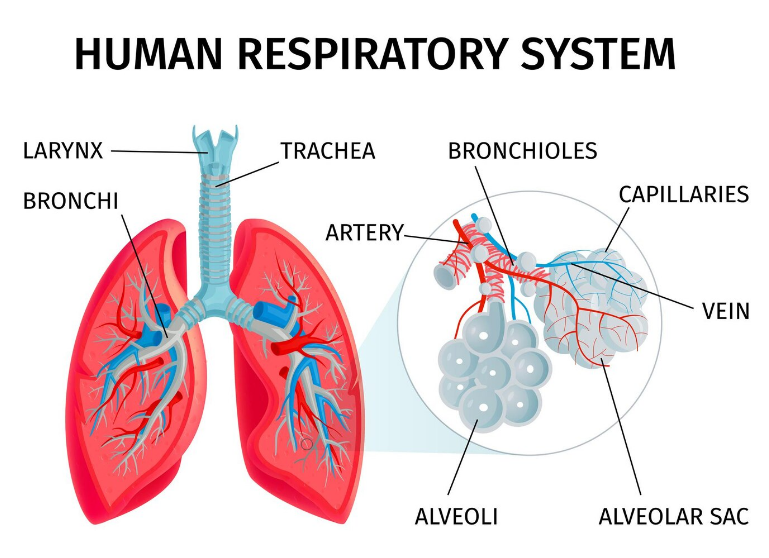
The anatomy of the lungs is similar to a tree, with the trachea acting as a “trunk” which branches out and eventually reaches the “leaves,” or alveoli.
The lungs connect directly to the trachea, which runs down the throat and into the chest. The trachea then branches off into bronchial tubes that enter the lungs. Bronchial tubes branch out into bronchioles that expand into the lungs. And finally, the tips of bronchioles contain hundreds of tiny elastic (“stretchy”) structures called alveoli, which help mediate the gas exchange of carbon dioxide and oxygen. From here, oxygen is absorbed into the blood and carried throughout the body. Adults have hundreds of millions of alveoli in their bodies.
The Right Lung
The right lung, compared to the left lung, is short but wide.
The right lung is divided into 3 lobes. Lobes are essentially different fundamental sections, or parts, of the lungs. In actuality, a patient can live without some lobes if doctors need to remove them. The 3 lobes of the right lung are called the superior, middle, and inferior lobes.
The Left Lung
The left lung on the other hand is actually smaller than the right lung because the heart occupies the spot where the middle lobe of the left lung would be if it had one. This space is called the cardiac notch, which is unique to the left lung.
The left lung has only 2 lobes – the superior and the inferior lobes. Unlike the right lung’s superior lobe, the left lung’s superior lobe has the lingula, which is an extension of it.
The Pleura
The pleura is a two-layered membrane that covers the lungs. The two layers are called the inner pleural layer (also known as the visceral pleura, which directly covers the lung) and the outer pleural layer or parietal pleura. These layers are separated by a cavity called the pleural space, a cavity filled with a slippery fluid called pleural fluid. Pleural fluid reduces friction that may occur during lung movement for breathing.
Check-Ups
When you go to the doctor, they will often tell you to take deep breaths as they place a stethoscope to your back and listen closely. This is because they are trying to analyze your breathing sounds. There are 4 points that doctors check to listen to your breathing sounds. The first 2 points are located between the spine and the shoulder blades in the upper part of your back. The second 2 points are located directly under your shoulder blades. By analyzing your breathing sounds, they are ensuring that your lungs are inhaling and exhaling properly.
In addition, doctors will sometimes measure a patient’s respiration rate. This tells them how many times a patient is inhaling and exhaling within a given timeframe. The average for adults is 12-20 breaths per minute.
Lastly, doctors will ask for any smoking history because smoking can directly contribute to the deterioration of lungs, which can lead to diseases that may even be fatal. The best practice is to avoid smoking entirely to help preserve the health of the lungs.
Review
- How many lungs are there? Two
- What body system are the lungs essential for? The Respiratory System
- How many lobes are in the right lung? Three
- How many lobes are in the left lung? Two
- What features are unique to the left lung? The Cardiac Notch and the Lingula
- What is the two-layered membrane that covers the lungs? The Pleura
DISCLAIMER: THIS BLOG POST DOES NOT PROVIDE MEDICAL ADVICE
The blog post and everything contained on it is for informational purposes only. No material on this site is intended to be a substitute for professional medical advice, diagnosis or treatment. Always seek the advice of your physician or other qualified health care provider with any questions you may have regarding a medical condition or treatment and before undertaking a new health care regimen, and never disregard professional medical advice or delay in seeking it because of something you have read on this website.

Recent Comments