
Guiding Questions
In this blog we’re going to be investigating what the doctor does about your sleep during a check-up. A lot of people don’t know what doctors are looking for, and they have questions like:
- What are common problems in sleep?
- How does a doctor diagnose me with a sleep problem?
All About Sleep Stages
Sleep is not just your body doing nothing. Your brain is actually very active during the night. Sleep is broken up into stages based on the type of brain activity found. Let’s learn about the different sleep stages.
- Stage 1 (N1) Light Sleep: The drifting off phase.Your heartbeat and breathing slow down. Your muscles begin to relax. This is where you might experience that sudden falling jerk, called a hypnic jerk. It takes only about 1–7 minutes. You wake very easily.
- Stage 2 (N2) Baseline Sleep: Light, but steady sleep. Your body temperature drops and your heart rate slows further. Your brain produces brief bursts of activity called sleep spindles, which help with memory processing and keeping you asleep despite outside noises. You spend about 50% of your total sleep time in this stage.
- Stage 3 (N3) Deep Sleep: The restorative phase. Also known as Delta sleep. This is the hardest stage to wake up from. Your body repairs tissues, builds bone and muscle, and strengthens the immune system. If you wake up feeling groggy or disoriented, you were likely pulled out of Stage 3.
- REM Sleep (Stage 4): The dreaming phase. Your brain activity looks remarkably similar to when you are awake. Your eyes move rapidly behind your lids, and your heart rate increases. To prevent you from physically acting out your dreams, your body enters a temporary state of paralysis called atonia. REM is crucial for emotional regulation and cognitive functions like creativity and problem-solving.
Common Sleep Problems
Some people are affected with maladies relating to their sleep. Some issues are neurological, some are respiratory, but almost all come with tiredness and poorer sleep quality. Lets learn about 4 common sleep disorders.
- Insomnia: The most common sleep complaint, affecting roughly a third of adults, characterized by trouble falling or staying asleep.
- Obstructive Sleep Apnea: Involves frequent breathing pauses during sleep, often causing loud snoring and daytime fatigue. Occurs when tissues in the mouth sag and block the airway.
- Restless Leg Syndrome: An uncontrollable, often painful, urge to move the legs, particularly when resting or trying to sleep.
- Narcolepsy: A neurological disorder causing extreme daytime sleepiness and phases of micro-sleep attacks.
Polysomnography
Polysomnography is the diagnostic test used to characterize sleep disorders. Let’s learn about how it is performed.
- The Arrival And Set Up: You typically arrive at a sleep center in the evening. The room usually looks like a hotel room but with a few extra gadgets. You’ll change into your pajamas. A sleep technologist will then begin the hook-up process, which takes about 45 to 60 minutes.They will apply various sensors using a specialized paste or medical tape. It looks like a lot of wires, but they are long enough to allow you to turn over in bed.
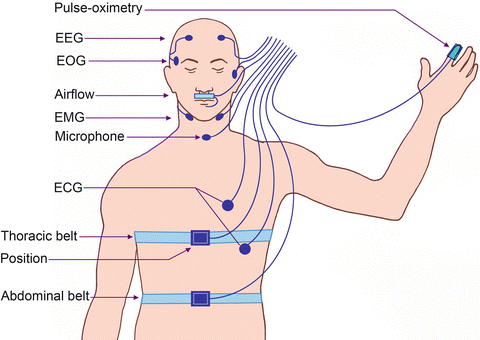
- The Sensor Map: Technicians monitor several different systems simultaneously. Sensors on your scalp to track brain waves to see if you are in light, deep, or REM sleep. Sensors near your eyes to track eye movements that are the hallmark of REM sleep. Sensors on your chin and legs to check for muscle tension or twitching. Sensors on your chest to monitor heart rhythm.
- Respiratory Monitoring: Since many sleep issues are breathing-related, specific equipment is used for your airway. Small tubes or sensors under the nose to measure airflow. Two elastic bands are placed around your chest and abdomen to measure the effort you are making to breathe. A small clip on your finger that uses light to measure the oxygen saturation in your blood.
- Calibration: Before you’re told to go to sleep, the technician will calibrate the equipment from a monitoring room. They will ask you to perform simple tasks over an intercom, such as blinking your eyes, flexing your muscles, and holding your breath. This ensures every sensor is reporting accurate data to their computer.
- The Sleep Session: Now, you simply try to sleep. The technician stays awake in a separate room, watching the data feeds and a low-light video monitor to note any unusual movements or sleepwalking. If the technician sees signs of severe sleep apnea early in the night, they may wake you up to perform a split-night study. This involves putting a CPAP mask on you for the second half of the night to see how you respond to the treatment.
- The Wake-Up And Results: In the morning, the technician will wake you up and remove the sensors. The study generates thousands of pages of data. A sleep technologist scores the record, marking every breath, movement, and sleep stage. Finally, a board-certified sleep physician reviews the scored data to provide a formal diagnosis.
Review
Here are some questions to review your knowledge about sleep.
- How long do you spend in baseline sleep? About 50% Of Your Total Sleep Time
- What percent of adults report experiencing insomnia? 33%
- How long does the hook-up process take in polysomnography? 45 – 60 Minutes
- Does the sleep technologist do the diagnosis? No
DISCLAIMER: THIS BLOG POST DOES NOT PROVIDE MEDICAL ADVICE
The blog post and everything contained on it is for informational purposes only. No material on this site is intended to be a substitute for professional medical advice, diagnosis or treatment. Always seek the advice of your physician or other qualified health care provider with any questions you may have regarding a medical condition or treatment and before undertaking a new health care regimen, and never disregard professional medical advice or delay in seeking it because of something you have read on this website.

Recent Comments