
Have you ever wondered?
How can a tiny bird inspire a train that travels 200 mph?
Why is a shark’s skin the secret to keeping hospitals clean?
Can a burr stuck to a dog’s fur change how we fasten our clothes?
Biological Blueprints
Biomimicry is the practice of examining nature’s models, systems, and elements to solve complex human problems.
- Design Efficiency: After millions of years of evolution, nature has already solved many problems involving energy, water, and survival with zero waste.
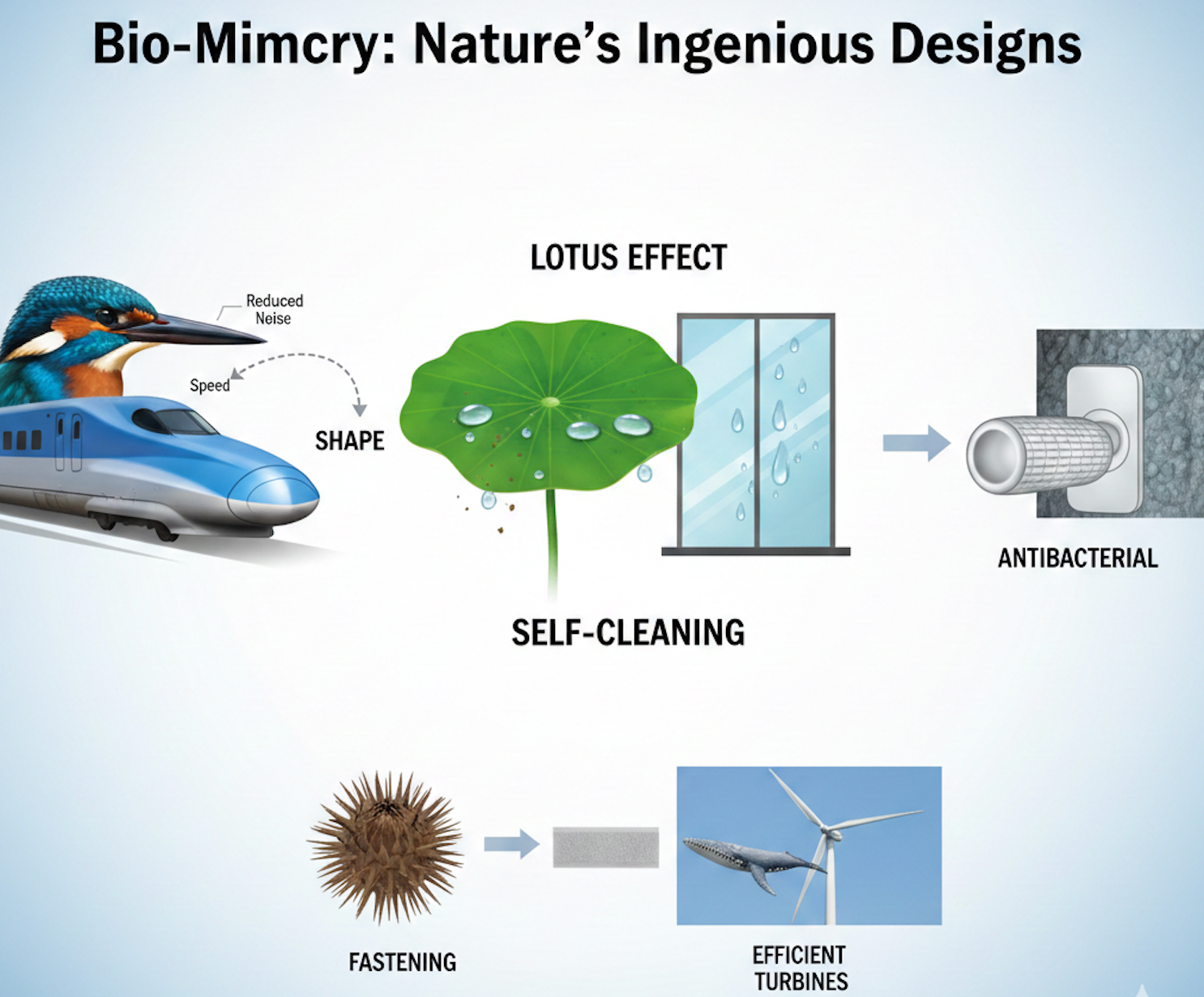
- The Shinkansen Example: Engineers redesigned the nose of the Japanese Bullet Train to mimic a Kingfisher’s beak. This solved the problem of “tunnel booms” (loud air pressure) and made the train 10% faster and 15% more energy-efficient.
- Aerodynamic Boxfish: Car designers modeled a “Bionic Car” after the Yellow Boxfish; despite its cube shape, the fish’s body is so aerodynamic that it helps cars use less fuel and stay more stable.
Structural Secrets and Sustainability
Scientists study the microscopic textures of organisms to create materials that are stronger, cleaner, and more sustainable.
- Shark Skin: Shark skin is covered in tiny scales called denticles that prevent bacteria from sticking. Scientists copied this texture to create hospital surfaces that repel germs without using chemicals.
- Whale Power: The bumps on a Humpback whale’s flipper (tubercles) allow it to turn sharply. Engineers now add similar bumps to wind turbine blades to help them capture more wind with less drag.
- The Lotus Effect: Tiny “nanopillars” on leaves repel water and dirt; scientists use this to create self-cleaning paint and stain-proof clothes.
Fun Facts
Here are some interesting facts about biomimicry:
- In 1941, George de Mestral noticed how cockleburs stuck to his dog’s fur. He looked under a microscope and saw tiny hooks, leading to the invention of Velcro.
- A shopping mall in Zimbabwe stays cool without expensive air conditioning because it was designed to mimic the self-cooling ventilation systems of termite mounds.
- Weight-for-weight, spider silk is stronger than steel. Scientists are trying to mimic its protein structure to create super-strong bridge cables and bulletproof vests.
Review
Let’s quickly recap what we learned about biomimicry:
- Which bird’s beak served as the model for the nose of the Japanese Bullet Train? Kingfisher
- What famous fastener was invented after studying how burs stick to animal fur? Velcro
- Scientists study the skin of which sea creature to create germ-repellent surfaces? Shark
- What insects inspired building designs that use natural cooling? Termites

Recent Comments