
Guiding Questions
- What are the nerves?
- What are the parts of the nerves?
- What are the functions of the nerves?
Overview
Have you ever sent a text message to a friend? Your phone sends that message very quickly through a network so it can reach the other person.
Your body has something similar. Instead of phones and signals, your body uses nerves and nerve cells to send messages. These messages travel between your brain, spinal cord, and the rest of your body.
The nervous system is like a messenger network that helps communicate information to and from your brain. Within the nervous system, nerves and neurons play a key role. Neurons, or nerve cells, are the specific cells that help carry messages. Neurons make up a larger network of nerves that allow your body to send and receive information.
Types of Nervous Systems
Nerves are bundles of fibers that carry messages between the brain, spinal cord, and the rest of the body. These messages travel as tiny electrical signals. Your nerves help your body do many important things. They allow you to move your muscles, feel sensations like heat or pain, and control important functions like breathing and heartbeat. They are what makes up your peripheral nervous system.
The nervous system is divided into two main parts: the central nervous system and the peripheral nervous system.
The central nervous system includes the brain and spinal cord. It is the control center of the body.
The peripheral nervous system includes all the nerves that branch out from the brain and spinal cord and travel throughout the body. These nerves carry messages back and forth between the central nervous system and the rest of the body.
Parts of a Nerve
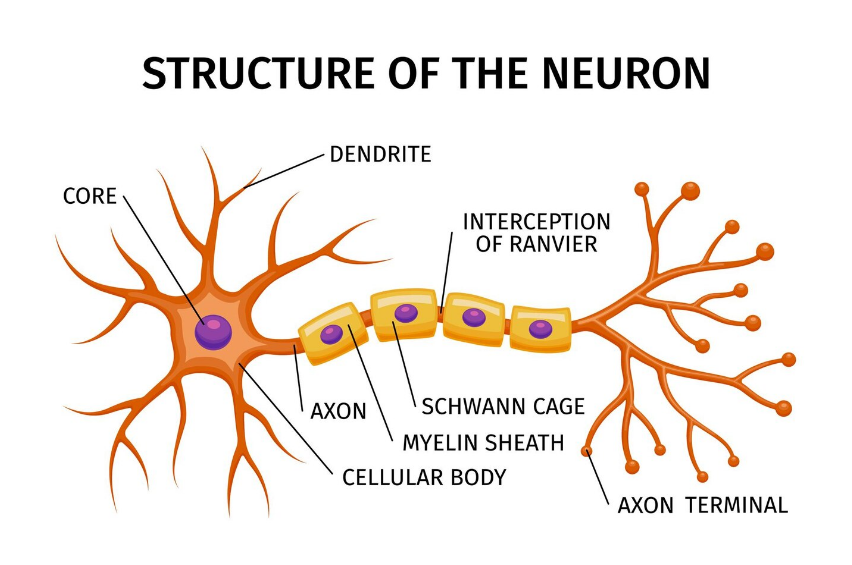
Nerves are made up of many nerve cells called neurons. Groups of these neurons bundle together to form nerves, which act like communication cables throughout the body. Each neuron has several important parts.
The cell body is the main part of the neuron. It contains the nucleus and helps keep the cell alive and functioning.
Dendrites are branch-like structures that receive messages from other neurons. They bring information toward the cell body.
The axon is a long, thin extension that carries electrical signals away from the cell body. Some axons can be very long, reaching from the spinal cord all the way to your feet.
Many axons are covered by a protective layer called the myelin sheath. This coating helps messages travel faster along the nerve.
Nerve Functions
Nerves have many important jobs in the body. Their main function is to send messages. Without nerves, your brain would not be able to communicate with the rest of your body. There are three main types of nerves.
Sensory nerves carry information from your body to your brain. For example, if you touch something hot, sensory nerves send a message to your brain telling it that the object is hot.
Motor nerves carry messages from the brain to muscles. These signals tell your muscles when to move.
Autonomic nerves control automatic body functions that you do not have to think about. These include breathing, digestion, and heartbeat.
Did You Know?
Your body contains thousands of miles of nerves that run throughout your body. If all the nerves in your body were stretched out, they could travel a very long distance!
Also, nerve signals travel extremely fast. Some signals can move up to about 250 miles per hour, which helps your body react quickly when something happens.
Review
- What are the cells that carry nerve messages called? Neurons
- What are the branch-like parts of neurons that receive signals? Dendrites
- What is the long extension that carries signals away from the cell body? Axon
- What type of nerves carry messages from the body to the brain? Sensory Nerves
- What type of nerves tell muscles to move? Motor Nerves
- What part of the nervous system includes the brain and spinal cord? Central Nervous System
DISCLAIMER: THIS BLOG POST DOES NOT PROVIDE MEDICAL ADVICE
The blog post and everything contained on it is for informational purposes only. No material on this site is intended to be a substitute for professional medical advice, diagnosis or treatment. Always seek the advice of your physician or other qualified health care provider with any questions you may have regarding a medical condition or treatment and before undertaking a new health care regimen, and never disregard professional medical advice or delay in seeking it because of something you have read on this website.

Recent Comments