
Guiding Questions
In this blog we’re going to be investigating what the doctor does about your eyesight during a check-up. A lot of people don’t know what doctors are looking for, and they have questions like:
- What is the difference between nearsightedness and farsightedness?
- How does a doctor tell what is wrong with my eye?
Eyesight Issues
Most people who wear glasses only have one of few issues like farsightedness, nearsightedness, and astigmatism. Let’s learn about these common eye issues.
- Nearsightedness: Also known as myopia, this issue causes difficulty seeing far away things. Close up object as seen properly though. This can be treated with a negative power lens.
- Farsightedness: Also known as hyperopia, this issue causes difficulty seeing nearby objects. Far away objects are seen better. This can be treated with a positive power lens.
- Astigmatism: An issue where all objects seem slightly fuzzy regardless of distance. This can be corrected with glasses, contacts, or surgery.
Refraction Tests
Refraction tests are the classic test used by doctors to find the eye’s power. It consists of the images being flipped in front of the eye and rated. Let’s learn about how these tests are performed.
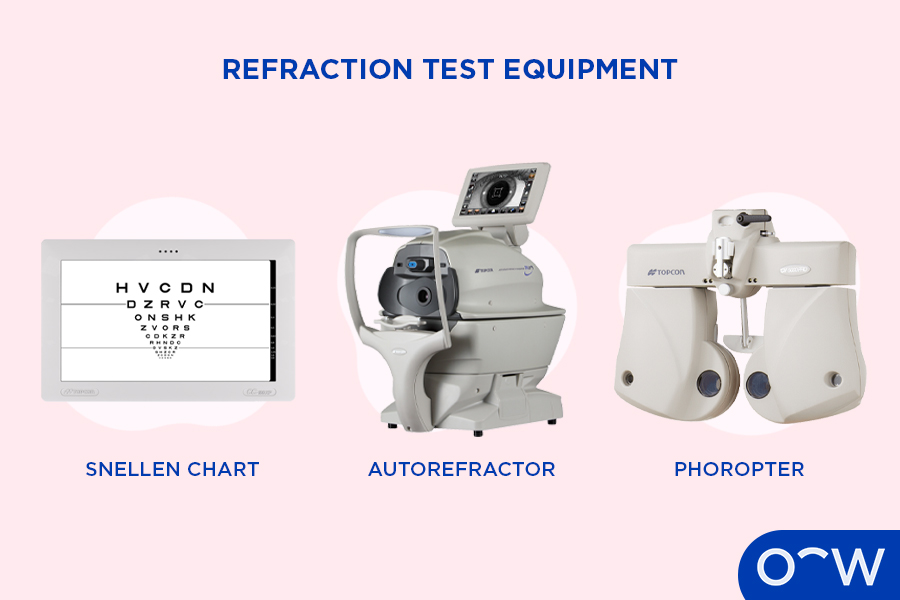
- The Pre-Test: Before the manual test, many offices use an autorefractor. You look at an image that moves in and out of focus.The machine measures how light is reflected off the back of your eye. It provides an early estimated starting point for the doctor so the manual test goes faster.
- Setting Up The Phoropter: You will sit behind a large instrument called a phoropter. It contains dozens of different lenses that the doctor can flip into place. The doctor will ask you to look at a Snellen eye chart across the room. You’ll focus on the smallest line of letters you can comfortably read.
- Finding The Distance Of Sight: The doctor begins by flipping lenses to see how much power is needed to bring the light to a focus point. The doctor will then ask which lens is better. By switching between lenses, the doctor is moving the focal point of the light forward or backward until it hits your retina exactly.
- Correcting For Astigmatism: If your eye isn’t perfectly round (astigmatism), light focuses at multiple points rather than one. The doctor uses cylindrical lenses to consolidate those points into a single sharp image. They will rotate the lens to find the specific angle where your cornea needs the most help.
- Refining the Results: Once the basic prescription is found, the doctor fine-tunes it. They may balance both eyes together to ensure they are working in harmony. Check your near vision if you are over 40, to see if you need a plus power for age-related eye issues.
- Understanding the Outcome: If the light focuses perfectly on the retina, you have emmetropia. If it focuses in front of the retina, you are nearsighted (myopia). If it focuses behind the retina, you are farsighted (hyperopia).
Review
Here are some questions to review your knowledge about eyesight and refraction tests.
- Farsightedness is also known as? Hyperopia
- What is the first machine used in a refraction test? The Autorefractor
- What is the name of the common eye chart? Snellen Eye Chart
- What is the shape of the lens used to correct astigmatism? Cylindrical
DISCLAIMER: THIS BLOG POST DOES NOT PROVIDE MEDICAL ADVICE
The blog post and everything contained on it is for informational purposes only. No material on this site is intended to be a substitute for professional medical advice, diagnosis or treatment. Always seek the advice of your physician or other qualified health care provider with any questions you may have regarding a medical condition or treatment and before undertaking a new health care regimen, and never disregard professional medical advice or delay in seeking it because of something you have read on this website.

Recent Comments