
Guiding Questions
In this blog we’re going to be investigating what the doctor does about your blood clotting during a check-up. A lot of people don’t know what doctors are looking for, and they have questions like:
- What are the reasons for needing a coagulation test?
- How is a coagulation test performed?
What is Coagulation And Why Does It Need To Be Tested?
Coagulation is the body’s ability to clot. This is aided by platelets. Coagulation tests measure the types and amounts of specific proteins that help with blood clotting, these proteins are called clotting factors. There are 2 specific reasons why clotting needs to be tested, blood that clots too easily and blood that doesn’t clot enough.
- Blood Clots Too Easily: This could lead to blood clotting inside the body. These clots are very dangerous, as they cause strokes, heart attacks, and lung blood clots.
- Blood Cannot Clot Well: This is an indication of a bleeding disorder. Injuries and surgeries could be fatal if the blood never stops flowing.
How Is A Blood Coagulation Test Performed?
A screening test, also known as a PT test, is first performed to check if your blood clots properly. Lets learn about the steps of a PT test.
- Sample Collection: The process begins with a standard blood draw. However, the tube used is a specific tube with a light blue top. This tube contains sodium citrate. Citrate binds to the calcium already in your blood. Since calcium is a required trigger for the clotting process, removing its availability keeps the blood liquid so it can be transported to the lab without premature clotting.
- Centrifugation: Once the lab receives the sample, they place it in a centrifuge. This machine spins the blood at high speeds to separate the heavy red blood cells from the plasma. Clotting factors are found in the plasma, so the lab technicians only need the plasma for the test.
- Reintroducing The Trigger: To start the test, the technician must undo what the sodium citrate did in step one. They add calcium back into the plasma sample. Depending on the specific test, they also add another trigger substance like a tissue factor or silica that mimics a blood vessel vessel injury.
- Clotting: Once the reagents are added, clotting begins. This is a complex chain reaction where inactive factors activate one another in a specific order. Prothrombin is converted into Thrombin. Thrombin then converts liquid Fibrinogen into solid Fibrin strands.
- Detection And Timing: The automated analyzer monitors the sample for the exact second those fibrin strands form. It usually does this in one of two ways:
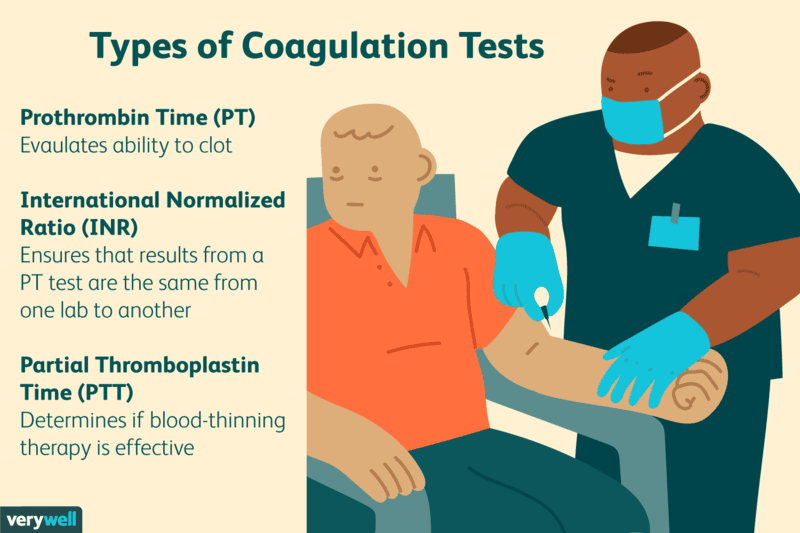
- Calculation Of Results: The raw score is the number of seconds it took to clot. For the common PT test, this is converted into an INR (International Normalized Ratio). This is a mathematical calculation that ensures a result in one lab means the same thing as a result in another, regardless of the brand of reagents used.
If a screening test comes back with an abnormal result, a doctor will then order a Factor Assay. This is a separate, more detailed test that measures the types and amounts of clotting factors found in your blood.
- The Process: The lab takes your plasma and mixes it with plasma that is known to be missing only one specific factor.
- The Result: If the plasma mix properly clots, you have enough of that factor. If it doesn’t, the lab can quantify exactly how much of that specific factor is present in your blood.
Review
Here are some questions to review your knowledge about blood coagulation tests.
- What are the proteins that help with blood clotting called? Clotting Factors
- What is one type of screening test? PT Test
- What element found in the blood is a trigger? Calcium
- What does it mean for a plasma mix to properly clot? Your Blood Has That Clotting Factor
DISCLAIMER: THIS BLOG POST DOES NOT PROVIDE MEDICAL ADVICE
The blog post and everything contained on it is for informational purposes only. No material on this site is intended to be a substitute for professional medical advice, diagnosis or treatment. Always seek the advice of your physician or other qualified health care provider with any questions you may have regarding a medical condition or treatment and before undertaking a new health care regimen, and never disregard professional medical advice or delay in seeking it because of something you have read on this website.

Recent Comments