
Guiding Questions
- What is the nervous system?
- What are the components of the nervous system?
- What are the functions of the nervous system?
- What are some common diseases related to the nervous system?
Overview
Every workplace you go to always has a structured command center. A chain of command helps information go from the head, director, or boss to the front-line employee.
Similarly, the nervous system is an intricate command center for your body. The brain is like the “boss” of the body, telling the body to perform various functions throughout the day.
Central Nervous System (CNS)
The CNS is made of the brain and spinal cord. This involves receiving signals that allow the brain to tell your body how to function.
The brain is one of the main organs in the body that regulates everything – ranging from body temperature to memories to feelings. It is connected to the spinal cord. The brain is divided into various different parts which each control different functions. It is overall a very complex organ that is vital to the body’s functions. Nerves that originate from the brain are called cranial nerves.
The spinal cord is a tube that is located in the center of the spine, within the bone that runs down your back. It connects directly to your brain. Its main role is to carry messages from the brain to other body parts. It’s divided into 3 parts – the cervical spinal cord (in the neck), the thoracic spinal cord (in the upper back), and the lumbar spinal cord (in the lower back). Nerves that originate from the spine are called spinal nerves.
Peripheral Nervous System (PNS)
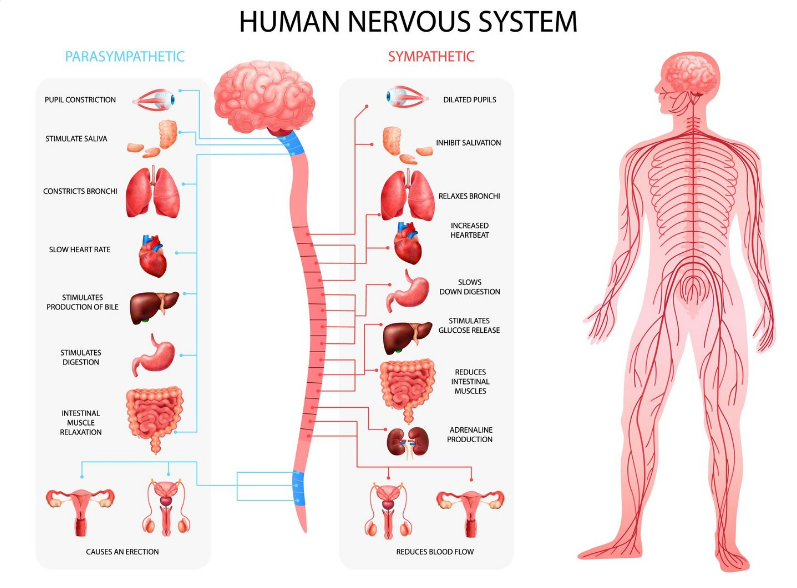
The PNS is made of a nerve network that branches out from the spinal cord to transmit information throughout the body. This system has 2 parts – the somatic nervous system (which controls voluntary movement) and the autonomic nervous system (which controls involuntary movement).
Nerves are extremely thin tissues located everywhere in the body that help relay signals to and from the brain through electrical impulses. Sensory nerves are nerves that transmit signals from body parts to the brain. They are responsible for your 5 senses – touch, taste, sight, sound, and smell. Motor nerves are nerves that transmit signals from the brain to the body parts. They are responsible for movement and other body functions.
Neurons, or nerve cells, transmit signals through the nerves. Motor neurons send signals to help you move. Sensory neurons are responsible for receiving signals from your 5 senses. Interneurons help motor and sensory neurons communicate; they also help you think and make decisions.
The Importance of Sleep
⅓ of your day is spent sleeping. It is an essential part of life – studies show that lacking sleep increases the chances for developing health problems in the future. Sleep functions as a “reset” for the brain, clearing out any toxins that have accumulated during the waking hours. It is important to get the appropriate amount of sleep to preserve your brain’s health.
Doctors recommend a certain amount of sleep based on your age.
- 4-12 month olds (infants): 12-16 hours of sleep including naps per every 24 hours
- 1-2 year olds: 11-14 hours of sleep including naps per every 24 hours
- 3-5 year olds: 10-13 hours of sleep including naps per every 24 hours
- 6-12 year olds: 9-12 hours of sleep per every 24 hours
- 13-18 year olds: 8-10 hours of sleep per every 24 hours
- Adults: 7+ hours of sleep per every 24 hours
Common Diseases
Diseases of the nervous system are different from diseases affecting other systems. Rather than just affecting the body, lots of these diseases often affect the behavior of people.
Alzheimer’s disease is when one slowly loses their memory and/or thinking abilities over time, usually present in senior citizens.
Cancer in the brain is when a mass of cells grows uncontrollably in the brain, creating a tumor that can become invasive and affect how the brain functions.
Other diseases like cerebral palsy and Parkinson’s disease can affect how someone grows and functions.
Some conditions can get treated, but others can simply only be helped or managed. To best maintain the health of the brain, it is important to get lots of sleep, exercise, and hydration.
Review
- What is the part of the nervous system containing the brain and spinal cord? CNS (Central Nervous System)
- What is the part of the nervous system containing the nerves? PNS (Peripheral Nervous System)
- What is the organ that helps regulate body functions? The Brain
- What is the tube connecting to the brain that runs down the spine? The Spinal Cord
- What are the nerves that help you use your 5 senses? Sensory Nerves
- What are the nerves that help you move and function? Motor Nerves
DISCLAIMER: THIS BLOG POST DOES NOT PROVIDE MEDICAL ADVICE
The blog post and everything contained on it is for informational purposes only. No material on this site is intended to be a substitute for professional medical advice, diagnosis or treatment. Always seek the advice of your physician or other qualified health care provider with any questions you may have regarding a medical condition or treatment and before undertaking a new health care regimen, and never disregard professional medical advice or delay in seeking it because of something you have read on this website.

Recent Comments