
Guiding Questions
- What is the digestive system?
- What are the components of the digestive system?
- What are the functions of the digestive system?
- What are some common diseases related to the digestive system?
Overview
An Amazon warehouse is a large facility that does many things. It takes in shipments of various products. Machines help to organize and break down shipments. People then sort through the shipments to find and prepare all of the useful items. Any useful and sellable items are shipped off to customers. Any damaged goods are discarded.
The digestive system actually functions in a very similar way! It takes in food that you eat. From the ingested food, it takes out any nutrients and other helpful components. The rest is removed by the intestines.
This system is very important for breaking nutrients down into components that the body can use for various things including obtaining energy, repairing cells, assisting with growth and development, and more!
- Amino acids are gained from proteins.
- Fatty acids and glycerol are gained from fats.
- Simple sugars are gained from carbohydrates.
The Digestive Tract
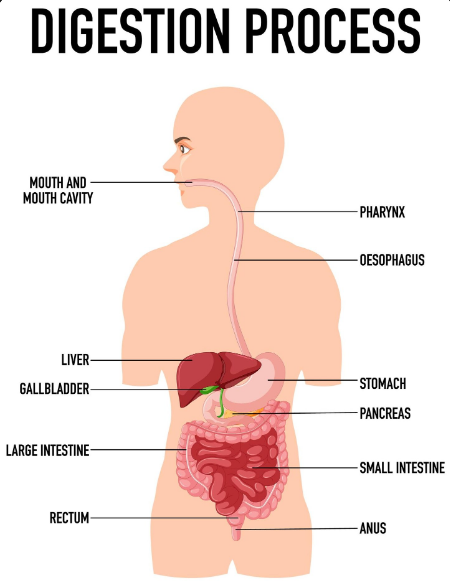
The digestive tract, also called the GI (gastrointestinal) tract, is the path that food takes in the body. This long path is made of hollow organs and tissues that stretch all the way from the mouth to the anus. A combination of movement and digestive juices help in the digestive process.
The digestive tract starts at the mouth. Chewing the food helps break food, specifically starches (a type of carbohydrate), down. Saliva also helps break food down.
The food then travels down the esophagus using peristalsis. Peristalsis is a common way of organs to move particles. The organ contracts in a specific way (such as from top to bottom, beginning to end, etc.) that moves the food forward. No food particles are broken down in the esophagus as there are no digestive juices present.
Food enters the stomach when the upper stomach muscle, a ringlike structure called the lower esophageal sphincter, relaxes in order to let the food in. It closes again to stop food from going back up the esophagus. The lower muscle mixes the food with stomach acid and digestive enzymes to break it down further. Specifically, it breaks down proteins.
By then, the food has been made into something called chyme, which is simply the contents of the stomach. The chyme is emptied into the small intestine, which mixes it with digestive juices of the body’s biliary tract. Small intestine digestive juice also helps break down starches, proteins, and carbohydrates. As the new contents are pushed forward with peristalsis, the small intestine walls absorb water and nutrients from the food. Special cells help nutrients cross the lining of the intestine, leading nutrients to the bloodstream. The remaining undigested waste goes into the large intestine.
The large intestine takes in waste including undigested food, fluid, and even old cells from other tissues of the GI tract. The large intestine changes all of the waste components into stool. Using peristalsis, the stool is moved into the rectum.
The rectum is the lower end of the large intestine. Stool is stored in the rectum until it is excreted by the anus.
The Biliary Tract
The biliary tract includes the pancreas, liver, bile ducts, and gallbladder which all release fluids for digestion.
The pancreas is located between the stomach and spine, on the right side of the body. Pancreatic juice breaks down carbohydrates, fats, and proteins.
The liver is an organ and gland on the body’s right side, located under the ribs. The gallbladder is tucked beneath. The bile from the liver breaks down fats and some vitamins; bile is stored in the gallbladder between meals and squeezed through bile ducts located inside and outside the liver. Bile ducts help connect the gallbladder to the small intestine, allowing bile to pass in between.
What’s on Your Plate?
Since your digestive tract processes anything and everything that you eat, it is important to manage your meals in a way that is healthy for your body. Below are the recommended portions of a meal:
Fruits and vegetables should make up ½ of a meal. It is important to consider color and variety because each fruit and vegetable gives your body different unique nutrients. Potatoes are actually not a healthy vegetable because they increase blood sugar since they are heavy in starch.
Whole and intact grains should make up ¼ of a meal. This can include whole wheat, quinoa, brown rice, oats, etc. and any foods made with wheat. They are much healthier for blood sugar levels compared to refined grains such as white rice and white bread.
Protein should make up ¼ of a meal. This includes certain meats, beans, and nuts. Avoid red meat and processed meats as they contain high fat levels.
Healthy plant oils should be consumed in small amounts. Healthy options include olive, sunflower, canola, peanut, and other types of oils.
Healthier beverages should be consumed instead of sugary drinks. Options include water, coffee, and tea. While milk and dairy products are healthy, it is recommended to only consume 1-2 servings in a day.
Combining these meal options with exercise can help ensure that one stays healthy and fit. By doing this, the digestive system is preserved and stays as healthy as possible, reducing the risk of developing a disease.
Common Diseases
There are quite a few diseases and conditions that may affect the digestive system. Here are a few:
Acid reflux and GERD (chronic acid reflux) occur when stomach acid accidentally comes into the esophagus. This may cause indigestion and/or heartburn.
Constipation and diarrhea are when there are abnormalities in stool.
Stomach ulcers are open sores found in the lining of the stomach that may cause pain and/or indigestion.
Celiac disease is when eating gluten, a type of protein, damages the intestine. Eating a lot of gluten may cause inflammation that can lead to damage. People with this disease can eat gluten-free foods which usually reverses any damage caused by eating gluten.
Cancer of the colon, esophagus, or liver occur when an invasive mass of cells called a tumor grow in part of the GI tract. This can be very harmful to the body.
Some conditions can be helped or treated by doctors; others can only be managed.
To help your body stay healthy, it is important to practice healthy lifestyle habits such as eating healthy, exercising regularly, and drinking plenty of water.
Review
- Where does the digestive tract start? The Mouth
- Where does the digestive tract end? The Anus
- What are the contents of the stomach called? Chyme
- What digestive juice does the pancreas make? Pancreatic Juice
- What digestive juice does the liver make? Bile
- What is the method of muscle contraction that moves food through the GI tract? Peristalsis
DISCLAIMER: THIS BLOG POST DOES NOT PROVIDE MEDICAL ADVICE
The blog post and everything contained on it is for informational purposes only. No material on this site is intended to be a substitute for professional medical advice, diagnosis or treatment. Always seek the advice of your physician or other qualified health care provider with any questions you may have regarding a medical condition or treatment and before undertaking a new health care regimen, and never disregard professional medical advice or delay in seeking it because of something you have read on this website.

Recent Comments