
Guiding Questions
- What is the respiratory system?
- What are the components of the respiratory system?
- What are the functions of the respiratory system?
- What are some common diseases related to the respiratory system?
Overview
When you go to a shopping mall, you probably notice that there are people constantly entering and constantly exiting. The people who are entering have a specific task to complete – or a specific item to buy. The people who are exiting have completed their tasks and have bought everything they need.
Well, the respiratory system is actually very similar to this analogy. This system takes in oxygen, which is vital for the body. It outputs carbon dioxide, which the body can’t use and needs to get rid of. Behind every breath you take is a complex process performed by your nose, mouth, lungs, and airways.
In addition, your respiratory system warms and moisturizes air breathed in, filters the air you breathe in, helps you talk and smell, and balances your body’s acidity levels (which are affected by carbon dioxide).
What is Gas Exchange?
Cells produce and use energy with the help of a cellular component called the mitochondria. The mitochondria is a very important part of a cell. It breaks down glucose and oxygen to produce a molecule called ATP, which our body uses for energy. This process, called cellular respiration, releases excess molecules: carbon dioxide and water. As oxygen is absorbed by tissues to be used for cellular respiration, carbon dioxide is released. Your respiratory system and circulatory system are both important for intaking oxygen for the cells to use and it’s also important for disposing of the carbon dioxide released.
The Upper Respiratory Tract
Your upper respiratory tract includes your nose, mouth, nasal cavity, oral cavity, and sinuses.
The nose is located on the front of your face, and the nasal cavity is a hollow area just behind it. Your nose warms, adds moisture to, and filters air when you inhale. It also allows you to smell. Lastly, it can affect how your voice sounds when you are speaking.
The mouth is important for both the respiratory and the digestive system. It is located just under your nose, and your oral cavity is located behind it. Your mouth is a vital component for the respiratory system because it is also a method of taking in air. It is larger and closer to the airway, so you can take in large amounts of air that doesn’t have to travel as far. However, it can’t filter air the way your nose can. In addition, breathing mainly through your mouth isn’t good because it can lead to dry mouth, bad breath, and dried out gums. Additionally, the mouth also affects how you talk.
Your sinuses, also called paranasal sinuses, air air-filled cavities within the bones of the face. There are 4 paired sinuses in your face – frontal, sphenoid, ethmoid, and maxillary. Their role in the respiratory system is to moisturize and warm the air you breathe in. However, they also play other important roles such as influencing your voice.
The Lower Respiratory Tract
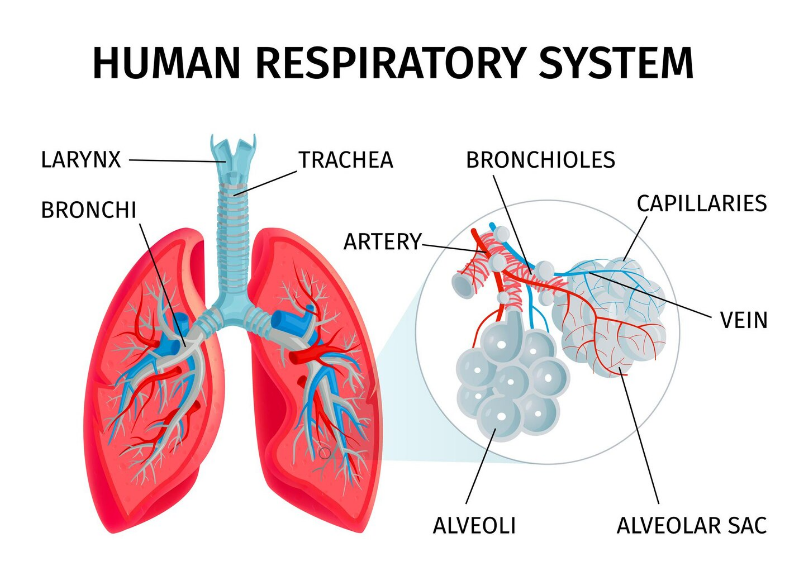
Your lower respiratory tract includes everything else – your larynx, lungs, and tracheobronchial tree. Your tracheobronchial tree is a series of tubes that get progressively smaller; it goes from your trachea to your bronchi and then to your bronchioles, which are small airways.
The larynx is commonly known as your voice box. It is located above your trachea (also known as your windpipe). It is a 4-5cm long hollow tube that helps you make sounds, and also lets air pass through your pharynx (throat).
The trachea starts at the end of your larynx and is located in your throat. At the end, it divides into the left and main stem bronchus. It is very close in location to your esophagus. The function of the trachea is to allow air to go to and from your lungs.
The bronchi help air spread into your lungs. They are connected to the trachea and help disperse any air that travels in through the trachea.
The bronchioles are a passage to the primary location for gas exchange within the alveoli of the lungs. The bronchioles are the smallest airways that branch out from the bronchi.
The lungs are the 2 large organs in the center of your chest that help you breathe. It is the primary location for gas exchange of oxygen and carbon dioxide.
The Diaphragm’s Role
The diaphragm is a muscle that is located below your lungs. This muscle helps you breathe in and breathe out by tightening and relaxing to “power” the lungs. Though it is not directly part of the respiratory tract, it is still an important part of breathing.
Common Diseases
There are quite a few disorders, conditions, etc. that can affect your respiratory system. The following are a couple of common conditions.
Chronic airway conditions: This is a group of conditions that affect how their airways function. A few common examples are COPD (chronic obstructive pulmonary disease), cystic fibrosis, and asthma.
Infections: Infections can affect both the upper and lower respiratory system. These are usually very common – examples include common colds and the flu.
Oxygen and carbon dioxide imbalances: If your blood does not have enough oxygen or has an excess amount of carbon dioxide, that can indicate an issue with the respiratory system. Examples are hypoxemia and hypercapnia. Since carbon dioxide affects the acidity level of your blood, abnormal carbon dioxide levels can also lead to acid-base imbalances in your blood.
Allergic rhinitis: Allergic rhinitis occurs when someone has an allergy that affects their airways, such as pollen, dust, etc.
Some of these, such as infections, can be avoided or prevented with proper hygiene (washing hands, using sanitizer, etc.) and vaccination. However, others (such as chronic airway conditions) may be related to genetics and may require a doctor to intervene.
To best help your respiratory system, it’s important to keep up good practices. Avoiding pollutants, smoking, and vaping can help protect your airways. Staying hydrated and exercising regularly can also maintain respiratory system health.
Review
- What is used by the body in gas exchange? Oxygen
- What is released by the body in gas exchange? Carbon Dioxide
- What is the larynx? The Voice Box
- What makes up the upper respiratory tract? The Nose, Mouth, Nasal Cavity, Oral Cavity, and Sinuses
- What makes up the lower respiratory tract? The Larynx, Lungs, Trachea, Bronchi, and Bronchioles
- What muscle helps the lungs inhale and exhale? The Diaphragm
DISCLAIMER: THIS BLOG POST DOES NOT PROVIDE MEDICAL ADVICE
The blog post and everything contained on it is for informational purposes only. No material on this site is intended to be a substitute for professional medical advice, diagnosis or treatment. Always seek the advice of your physician or other qualified health care provider with any questions you may have regarding a medical condition or treatment and before undertaking a new health care regimen, and never disregard professional medical advice or delay in seeking it because of something you have read on this website.

Recent Comments