
Guiding Questions
In this blog we’re going to be investigating what the doctor does about your Temperature during a check-up. A lot of people don’t know what doctors are looking for, and they have questions like:
- How does a doctor check my temperature?
- What does my temperature indicate?
Temperature Measuring Techniques
Modern medicine is moving away from liquid based thermometers and adopting new digital thermometer technologies. Examples include infrared thermometers and heat sensor thermometers. Doctors also have the choice of choosing any one of the variety of locations to measure temperature. Let’s learn about the various locations used to measure body temperature.
- Oral: Oral temperature is taken by a heat sensor thermometer that is placed under the tongue. This technique is most accurate in adults and children over 3 years of age. Drawbacks include the inability to keep the mouth closed for long in young children and people with breathing difficulties.
- Rectal: Rectal temperature is taken by a heat sensor thermometer that is inserted 0.5-1 inch into the anal opening. This is the most accurate temperature measurement for infants or young children. After 4-5 of age, an oral measurement is recommended. These measurements typically run 0.5-1 degrees fahrenheit hotter than oral measurements
- Forehead: This temperature is taken by an infrared thermometer. The IR thermometer is typically aimed at the temporal artery on the forehead. The main benefits of this method are good accuracy across all ages, no contact, and quick readings. These measurements typically run 1 degree fahrenheit cooler than oral readings.
- Ear: Ear/Tympanic measurements are taken by an infrared thermometer placed in the ear canal. This technique gives fast accurate measurements and may be preferable to rectal or oral measurements in children. Due to the small size of the ear canal, this location isn’t recommended for children under 6. These readings usually run 0.5 to 1 degree Fahrenheit hotter than oral measurements.
- Armpit: This location is measured using a heat sensor thermometer placed in the armpit. This method is not widely used due to less accurate readings. The measurements taken here run 0.5 to 1 degree fahrenheit cooler than oral readings.
Low, Healthy, And High Temperature
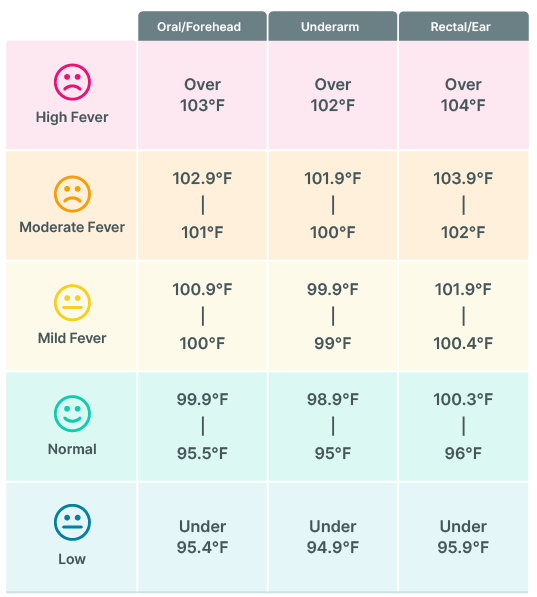
The following section will address the ranges of human body temperature considered as low, healthy, and high. All the values stated will be from oral measurements, so make sure to factor in the 0.5-1 degree differences between measurement locations.
- Low: Low temperature is any value below 95 degrees F. This is called hypothermia and requires immediate medical attention. Factors that increase the risk of hypothermia include: cold weather, elderly age, hypothyroidism, or sepsis.
- Healthy: Healthy temperature is anything between 95.9 – 99.5 degrees F. This is the range in which the body works best. Keep in mind everyone has their own average temperature and should talk with their doctor about any significant deviations. The medically accepted average is 98.6 F, though new research indicates the true average may be lower.
- High: Any temperature above 100.4 F is considered a fever. This is a sign that the body is fighting off an infection. Based on other symptoms and the severity of the high temperature, medical attention may be needed, or at home rest may be sufficient.
Review
Here are some questions to review your knowledge about temperature.
- Where should an oral thermometer be placed? Under The Tongue
- Under what age should ear measurements not be taken? 6 Years Of Age
- What are factors that increase the risk of hypothermia? Cold Weather, Elderly Age, Hypothyroidism, and Sepsis
- Above what temperature is considered a fever? 100.4 F
DISCLAIMER: THIS BLOG POST DOES NOT PROVIDE MEDICAL ADVICE
The blog post and everything contained on it is for informational purposes only. No material on this site is intended to be a substitute for professional medical advice, diagnosis or treatment. Always seek the advice of your physician or other qualified health care provider with any questions you may have regarding a medical condition or treatment and before undertaking a new health care regimen, and never disregard professional medical advice or delay in seeking it because of something you have read on this website.

Recent Comments