
Guiding Questions
In this blog we’re going to be investigating what the doctor does about your height, weight, and BMI during a check-up. A lot of people don’t know what doctors are looking for, and they have questions like:
- Do I have the correct amount of weight for my height?
- What is BMI, and how do I calculate it?
Height
Height is the distance between the bottom of your feet to the top of your head. Height varies among everybody and there is no “correct” height to be. Only your doctor can say if there is any issue with your height, so this blog will only discuss overall trends in height.
- Height In Men: The global average height for men is around 5’ 7”. Men typically reach their maximum height at a later age than women.
- Height In Women: Women on average are 7% shorter than men. The global average height for women is around 5’ 3”. Women usually reach their maximum height at an earlier age than men.
- How To Measure Height: Height can be measured very easily by anyone. First stand barefoot against a wall with your heels together, then look straight ahead. Place a flat object like a book on top of your head. Then mark the distance from the floor to the flat object, this is your height.
Weight
Weight is the force you exert on the ground. It is indicative of the amount of mass you contain. A very high or very low amount of weight is a sign of concern for doctors. Keep in mind everyone has their own healthy weight they should maintain and should talk to their doctor about any concerns.
- Weight And Height: As height increases, the preferable weight also increases. For men, weight should be around 106 lbs for the first 5 feet, then 6 lbs for every inch after. For women weight should be around 100 lbs for the first 5 feet, then 5 lbs for every inch after.
- Weight And Age: Children and teens of a certain height typically have a lower weight than an adult of the same height. Furthermore, the elderly may lose ½ lb every year due to age.
- How To Measure Weight: Weight is typically measured using a scale. These are either mechanical or electronic pads that you can stand on and take your weight measurement.
BMI
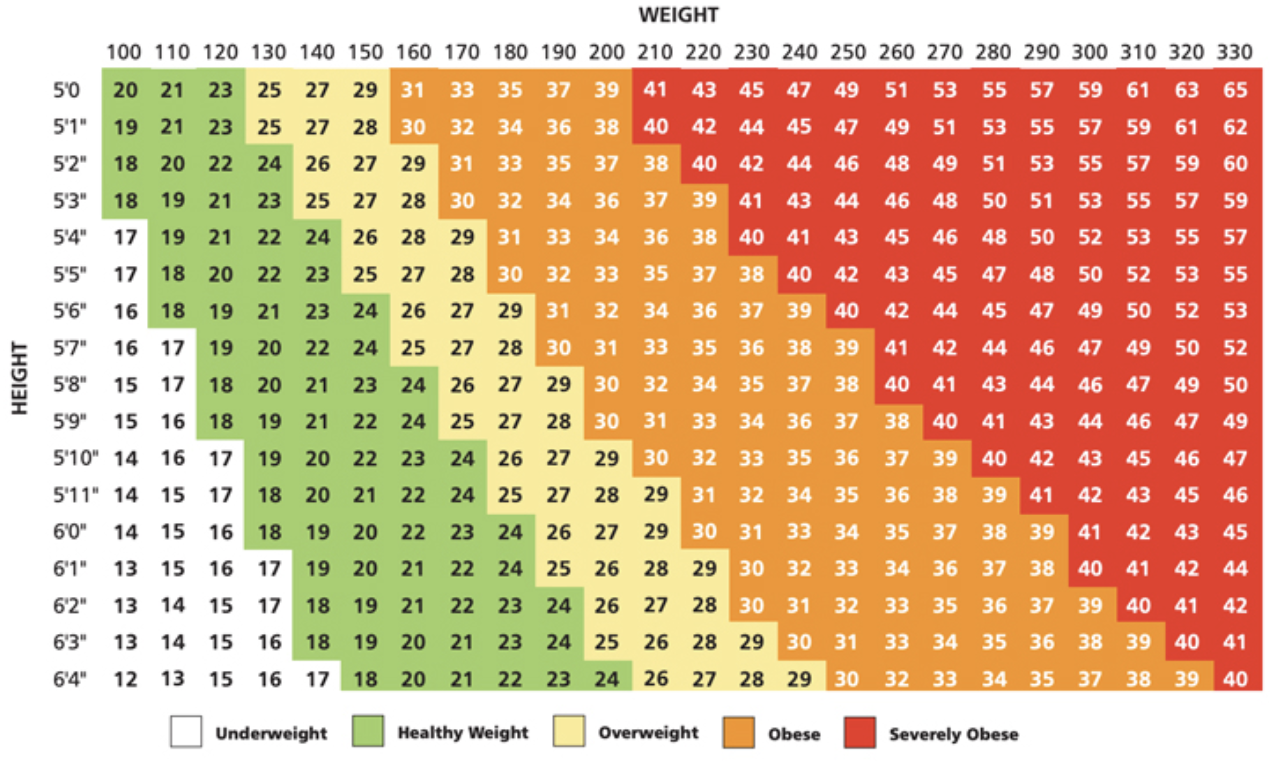
BMI is a measure of body fat using your height and weight. It can estimate whether someone is underweight, overweight, or healthy.
- Healthy Range: The healthy range for BMI is between 18.5 and 24.5. Anything below 18.5 is considered underweight, and anything over 24.5 is considered overweight or obese.
- Shortfalls: BMI does not take into account the muscle mass of a person. Therefore people with a lot of muscle could be incorrectly considered overweight. Furthermore, BMI is only a number and it is up to your doctor to determine whether you are healthy.
- How To Measure BMI: BMI is founded using the following formula:
((Weight in lbs)/((Height in inches)^2))x703. For metric units do all the same except do not multiply by 703.
Review
Here are some questions to review your knowledge about height, weight, and BMI.
- What is the global average height for women? 5’ 3”
- After 5 feet, how many lbs per inch of height should men have? 6 lbs
- A BMI of 26 is considered what? Overweight
- What is the formula to calculate BMI in U.S. units? ((Weight in lbs)/((Height in inches)^2))x703
DISCLAIMER: THIS BLOG POST DOES NOT PROVIDE MEDICAL ADVICE
The blog post and everything contained on it is for informational purposes only. No material on this site is intended to be a substitute for professional medical advice, diagnosis or treatment. Always seek the advice of your physician or other qualified health care provider with any questions you may have regarding a medical condition or treatment and before undertaking a new health care regimen, and never disregard professional medical advice or delay in seeking it because of something you have read on this website.

Recent Comments